POP Ganesha Idols: What You Need to Know
August 15, 2026
Ganesh Chaturthi is one of India’s most loved festivals. It is a celebration of faith, tradition, family and joy. Every year, beautifully decorated Ganesha idols fill our homes, streets and public spaces.
Devotees immerse POP idols in water bodies after the festival.
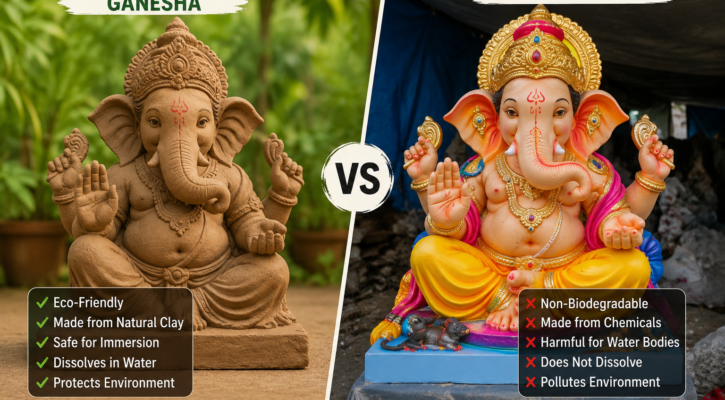
But once the celebrations are over and the idol is immersed, have we ever stopped to think about what happens n→ “Artisans make many of these idols from Plaster of Paris (POP).
and decorated with bright paints, glitter and other materials. They may look beautiful during the festival, but the materials used to make and decorate them can create environmental concerns after immersion.
So this Ganesh Chaturthi, perhaps we should ask a slightly different question:
“Which Ganesha idol is beautiful not only for our homes, but also for our environment?”
What Is POP and Why Is It Used for Ganesha Idols?
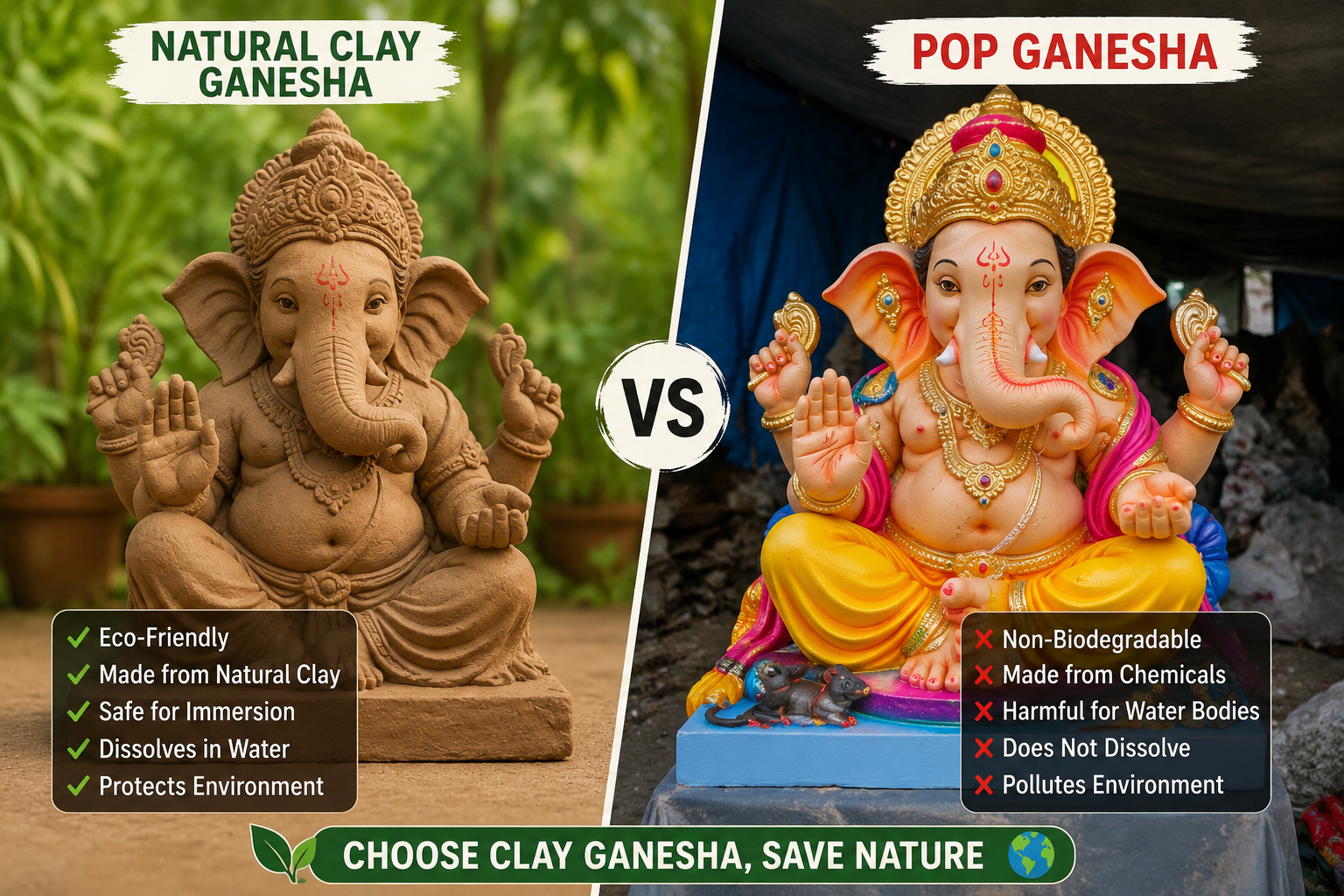
POP stands for Plaster of Paris, a gypsum-based material that is easy to mould into different shapes.
It is lightweight, dries quickly and allows artisans to create large idols with detailed designs. These qualities have made POP a popular material for Ganesha idols.
The concern begins after the festival.
Unlike natural clay, POP does not dissolve quickly in water. Environmehttp://Why Srimukhalingam Temple is the Ultimate Dakshina Kashintal guidance from India’s Central Pollution Control Board has highlighted the longer dissolution time of POP idols compared with traditional clay idols.
This means that after immersion, pieces of the idol may remain in water for a considerable period.
What Happens When POP Idols Are Immersed?
Imagine a lake after Ganesh Chaturthi.
Hundreds or even thousands of idols may have been immersed. Some idols break apart, while others can remain partially intact. The material may settle in the water or around the edges of the water body.
The concern is not limited to POP alone.
Paints, coatings, glitter, plastic accessories and other decorative materials can also become part of the waste entering the water.
When large quantities of such material enter a water body, they can affect the cleanliness and quality of the surrounding environment.
This is why responsible immersion is an important part of an eco-friendly Ganesh Chaturthi.

What About the Colours Used on Ganesha Idols?
The colours are often what make a Ganesha idol look attractive and festive.
But not all paints and coatings are the same.
Some idol paints and decorative coatings may contain substances that are not suitable for natural water bodies. When painted idols are immersed, these materials can enter the surrounding water.
That is why choosing an idol should not be based only on its appearance.
Before buying a Ganesha idol, ask a few simple questions:
- What is the idol made from?
- Does it contain POP?
- What type of colours have been used?
- Does it contain plastic or synthetic decorations?
A few questions can help us make a more informed and environmentally responsible choice.
Is POP the Only Problem?
Not really.
The environmental impact of Ganesh Chaturthi can come from several sources.
Plastic decorations, thermocol, glitter, synthetic flowers, plastic bags and other non-biodegradable materials can also become waste during the festival.
It is also about changing the way we decorate, celebrate and dispose of festival waste.

Why Choose a Natural Clay Ganesha?
Natural clay has a simple connection with the earth.
A properly made A properly made natural clay Ganesha idol can be a more environmentally responsible alternative to POP. Clay can break down more naturally, especially when compared with materials that persist much longer in water. can be a more environmentally responsible alternative to POP. Clay can break down more naturally, especially when compared with materials that persist much longer in water.
However, we should not assume that every idol labelled “eco-friendly” is automatically completely natural.
Before buying, check the material carefully.
Ask the seller whether the idol is made from natural clay, whether POP has been added, and what type of colours and decorations have been used.
Choosing a simple clay idol with minimal synthetic decoration can be a meaningful step towards a greener celebration.

Do We Really Need a Huge Ganesha Idol?
This is another question worth asking.
A large Ganesha idol can certainly create a powerful visual impact. But does the size of the idol determine the strength of our devotion?
Not really.
A small clay Ganesha can hold just as much spiritual meaning as a large decorative idol.
The size, colour or cost of the idol does not measure our faith.
Sometimes, choosing something simple can make the festival even more meaningful because our focus moves from decoration to devotion.
What Can We Do This Ganesh Chaturthi?
Going eco-friendly does not mean giving up the joy of Ganesh Chaturthi.
It simply means celebrating more responsibly.
1. Choose a Natural Clay Idol
Look for a Ganesha idol made primarily from natural clay. Ask the seller about the material instead of relying only on an “eco-friendly” label.
2. Reduce Unnecessary Decorations
Flowers, leaves, cloth and reusable decorations can make your home look beautiful without creating excessive plastic waste.
3. Avoid Plastic and Thermocol
Try to reduce single-use plastic, thermocol and other materials that can become waste after the festival.
4. Follow Local Immersion Guidelines
If your local authorities provide designated immersion tanks or specific immersion locations, use them.
This can help reduce pressure on natural lakes, ponds and rivers.
5. Keep the Immersion Area Clean
Flowers, plastic bags, packaging and decorative waste should not be left behind.
The celebration should end with responsibility.

Let Children Be Part of the Change
Ganesh Chaturthi is also a wonderful opportunity to teach children about nature.
Instead of simply buying an idol, families can try making a small clay Ganesha together.
Children can learn that traditions and environmental responsibility do not have to be separate.
They can celebrate the festival while also understanding where materials come from and what happens to them after the festival.
That lesson can stay with them much longer than the festival itself.
One Small Choice Can Start a Bigger Change
You may wonder:
“Will choosing one clay Ganesha really make a difference?”
One family choosing clay may seem like a small step.
But imagine thousands of families making the same decision.
That is how individual choices become community change.
We don’t have to completely change the way we celebrate Ganesh Chaturthi.
We only need to make better choices wherever we can.
This Year, Let’s Ask a Different Question
When you visit the market to buy your Ganesha idol, don’t ask only:
“Which one is the most beautiful?”
Ask:
“Which one is beautiful for my family and kinder to nature?”
Choose natural clay where possible.
Reduce unnecessary synthetic decorations.
Avoid plastic waste.
Follow responsible immersion practices.
And remember that devotion does not need to be measured by the size, colour or cost of an idol.
A Festival Should Leave Memories, Not Pollution
Ganesh Chaturthi is about welcoming Ganesha with love and sending him off with devotion.
This year, let’s add one more thing to that tradition — responsibility towards nature.
A simple clay Ganesha may look less glamorous than a huge, colourful idol.
But its message can be much bigger.